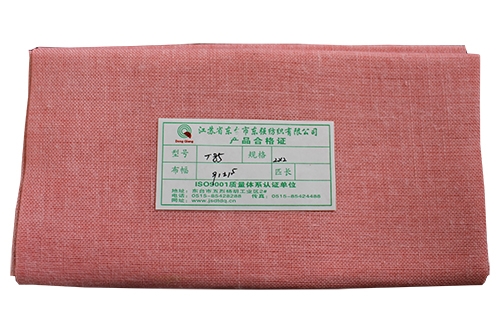
How to judge the resistance of an industrial cloth?
Judging the pressure resistance of an industrial cloth is an important step to ensure that it can withstand the expected pressure in actual applications and ensure the quality and safety of the engineering. Here are a detailed step and consideration factors to evaluate the resistance of industrial cloth:
1. Understand the basic attributes of industrial cloth
Before starting the evaluation, you need to understand the basic attributes of industrial cloths, such as materials, thickness, density, weaving methods, etc. These attributes will directly affect its pressure resistance.
Material: The industrial cloth of different materials has different pressure resistance. For example, synthetic fibers such as nylon and polyester usually have high strength and pressure resistance, while natural fibers such as cotton and hemp may be weak.
Thickness and density: Thicker and dense industrial cloths usually have better pressure resistance because they can provide better support and buffer.
Weaving: Different weaving methods will affect the structure and strength of industrial cloth. For example, the flat and oblique weaving method can provide good pressure resistance, while the mesh woven method may be weaker.
2. Laboratory testing
In the laboratory environment, a series of experiments can be used to evaluate the resistance of industrial cloth. These experiments usually include stretch testing, compression testing, tearing testing, etc.
Stretching test: The industrial cloth is stretched by stretching the experimental machine to measure its stretch strength and the elongation of the break. This can evaluate the resistance of industrial cloth when stretching force.
Compression test: The industrial use is placed under the compressed experiment, and the pressure gradually increases to observe its deformation and rupture. This can evaluate the resistance of industrial cloth when being compressed.
Torn test: Tear the industrial cloth by tearing the experimental machine to measure its tearing strength and tearing scalability. This can evaluate the pressure resistance of industrial cloth when being torn.
Industrial cloth
Third, actual application test
In addition to laboratory testing, it is also necessary to conduct pressure resistance to industrial cloth in the actual application environment. This can be implemented by simulating actual working conditions or using actual workpieces.
Simulation test: Under the conditions of simulation, the industrial use is placed in a specific pressure environment to observe its deformation, rupture or failure. This can help evaluate the resistance of industrial cloth in practical applications.
Real workpiece test: Apply industrial cloth to actual workpieces and test under actual work conditions. Observe the performance of industrial cloth when undergoing the pressure of workpieces, such as deformedness, rupture or failure. This can more directly evaluate the resistance of industrial cloth in practical applications.
Fourth, comprehensive consideration of evaluation results
After completing the laboratory testing and actual application test, the various evaluation results need to be comprehensively considered to determine the resistance of industrial cloth. This includes analysis of various test data, the performance differences of comparing different industrial cloths, and considering the actual application needs.
Analysis test data: Analyze and compare the data of laboratory testing and actual application tests, and understand the resistance performance of industrial cloth under different conditions.
Comparison performance differences: The performance differences of different industrial cloths, including pressure resistance, abrasion resistance, chemical corrosion resistance, etc. This helps to choose the most suitable industrial cloth for specific applications.
Considering actual application requirements: According to the actual application requirements, such as working environment, workpiece type, pressure, etc., comprehensively consider whether the resistance of industrial cloth resistance meets the requirements.
Through the above steps and considerations, it can comprehensively evaluate the resistance of an industrial cloth to ensure that it can withstand the expected pressure in practical applications and ensure the quality and safety of the project.